> For the complete documentation index, see [llms.txt](https://helpdesk.smaply.app/llms.txt). Markdown versions of documentation pages are available by appending `.md` to page URLs; this page is available as [Markdown](https://helpdesk.smaply.app/journey-maps/how-to-change-a-cards-type.md).

# How to change a card's type

Convert a card to a different type in place, keeping its text, colour, personas, card tags, and comments.

Turn a rough note you jotted down as a text card while drafting a map into a real, tracked pain point, or promote a pain point you've worked on into an opportunity or solution, all without rebuilding the card.

{% hint style="info" icon="tag" %}
Available on the **Repository** plan and above.
{% endhint %}

{% hint style="info" icon="clipboard-list" %}

#### In this guide

1. [How to change one card's type](#how-to-change-one-cards-type)
2. [How to change the type of several cards at once](#how-to-change-the-type-of-several-cards-at-once)
3. [Which card types you can convert between](#which-card-types-you-can-convert-between)
4. [What carries over when a card changes type](#what-carries-over-when-a-card-changes-type)
5. [What happens to the portfolio item](#what-happens-to-the-portfolio-item)
6. [How to undo a type change](#how-to-undo-a-type-change)
   {% endhint %}

***

#### How to change one card's type

{% stepper %}
{% step %}
**Select the card and open its three-dot menu**

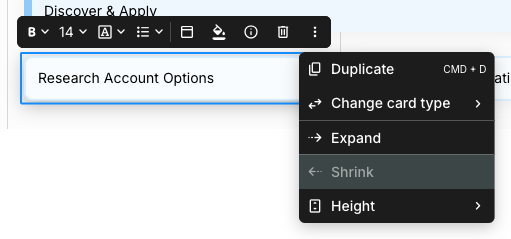
Click the card once, then click the three-dot button at the right end of the floating toolbar. This is unavailable on a [locked journey map](/journey-maps/how-to-lock-a-journey-map.md), since locking hides the card toolbar entirely.

<figure><img src="https://1197101183-files.gitbook.io/~/files/v0/b/gitbook-x-prod.appspot.com/o/spaces%2For99xDEElfps9uMDY60K%2Fuploads%2Fgit-blob-491bbcc13c00844df6d0dc9142b70b62977fb897%2Fjourney-maps-cards-height-01-overflow-menu.png?alt=media" alt="A selected text card on a journey map with its three-dot overflow menu open. The menu lists Duplicate with a CMD + D shortcut, Change card type with a submenu arrow, Expand, Shrink greyed out, and Height with a submenu arrow."><figcaption><p>Change card type sits in the card's three-dot menu</p></figcaption></figure>
{% endstep %}

{% step %}
**Click Change card type**

The submenu opens on click, not on hover.

<figure><img src="https://1197101183-files.gitbook.io/~/files/v0/b/gitbook-x-prod.appspot.com/o/spaces%2For99xDEElfps9uMDY60K%2Fuploads%2Fgit-blob-81673d9fc0945a4b71b9455228e7cb7d2df81eb2%2Frn-2026-09-card-type-conversion.png?alt=media" alt="The Change card type submenu open beside a card&#x27;s three-dot menu, listing Text, Stage, Opportunity, Pain point, Solution, Goals, and Risk, each with its own icon."><figcaption><p>The conversion list: Text, Stage, and your account's portfolio item types</p></figcaption></figure>
{% endstep %}

{% step %}
**Pick the new type**

The card's current type is greyed out and can't be clicked. Converting between **Text** and **Stage** applies immediately, with no confirmation.
{% endstep %}

{% step %}
**Confirm the details if you picked a portfolio type**

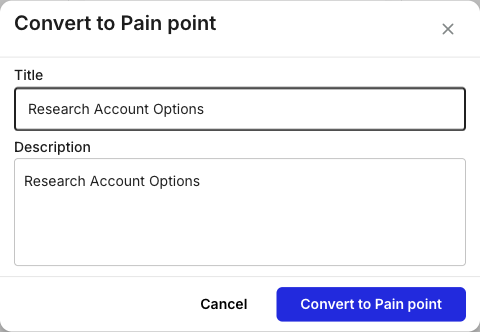
A **Convert to \[type]** dialog opens with **Title** and **Description**, both pre-filled with the card's text. Edit either one, then click **Convert to \[type]**.

<figure><img src="https://1197101183-files.gitbook.io/~/files/v0/b/gitbook-x-prod.appspot.com/o/spaces%2For99xDEElfps9uMDY60K%2Fuploads%2Fgit-blob-3c49ec7e4560987869982fb9c962927ba396386c%2Fjourney-maps-card-convert-11-convert-to-pain-point-confirm-crop.png?alt=media" alt="The Convert to Pain point dialog with a Title field and a Description field, both pre-filled with the card&#x27;s text, and Cancel and Convert to Pain point buttons."><figcaption><p>Convert to Pain point, with the card's text pre-filled</p></figcaption></figure>
{% endstep %}
{% endstepper %}

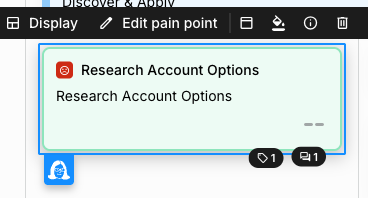
The card keeps its place in the lane and takes on the new type's shape and controls, so a converted portfolio card gains **Display** and **Edit \[type]** on its toolbar.

<figure><img src="https://1197101183-files.gitbook.io/~/files/v0/b/gitbook-x-prod.appspot.com/o/spaces%2For99xDEElfps9uMDY60K%2Fuploads%2Fgit-blob-2594be6d1055d3b41fe8d597c0360eed6024e971%2Fjourney-maps-card-convert-12-after-text-to-pain-point-crop.png?alt=media" alt="A pain point card on a journey map after conversion, showing the pain point icon with the item title, the description below it, the card&#x27;s tag and comment badges, and a toolbar above with Display and Edit pain point buttons."><figcaption><p>The converted card, now with the portfolio item's own controls</p></figcaption></figure>

***

#### How to change the type of several cards at once

The bulk action bar carries the same action under a shorter label, **Change type**. It appears only when every card in the selection is the same type and that type supports conversion, so adding a slider or image card to the selection drops it off the bar.

{% stepper %}
{% step %}
**Select the cards**

Hold `Shift` and click each card, or use **Select all cards** from a lane or column menu. See [How to bulk edit cards](/journey-maps/how-to-bulk-edit-cards.md) for the full selection and bulk-action flow.
{% endstep %}

{% step %}
**Click Change type on the bulk bar**

The bar names the selection, for example **Bulk edit · 2 text cards**. The type list is the same one you get on a single card.

<figure><img src="https://1197101183-files.gitbook.io/~/files/v0/b/gitbook-x-prod.appspot.com/o/spaces%2For99xDEElfps9uMDY60K%2Fuploads%2Fgit-blob-f0708e47b74f9b99e070adba89b4741138fc3575%2Fjourney-maps-card-convert-16-bulk-bar-two-text-cards-crop.png?alt=media" alt="The bulk action bar at the bottom of the journey map editor, reading Bulk edit, 2 text cards, with bold, font size, font, and height controls, then fill, Header, Tags, Persona, Change type, and Delete actions."><figcaption><p>Change type on the bulk bar</p></figcaption></figure>
{% endstep %}

{% step %}
**Pick the new type**

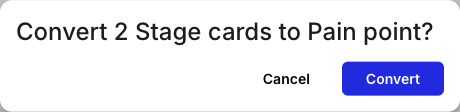
**Text** and **Stage** apply to the whole selection at once. Converting to a portfolio type asks for a single confirmation instead of the Title and Description dialog, and each card's own text becomes its new item's title.

<figure><img src="https://1197101183-files.gitbook.io/~/files/v0/b/gitbook-x-prod.appspot.com/o/spaces%2For99xDEElfps9uMDY60K%2Fuploads%2Fgit-blob-d6df172666e99fdec937207df003b6c8fff6e5c8%2Fjourney-maps-card-convert-20-bulk-convert-to-pain-point-dialog-crop.png?alt=media" alt="A confirmation dialog reading Convert 2 Stage cards to Pain point? with Cancel and Convert buttons."><figcaption><p>Bulk conversion to a portfolio type asks for one confirmation</p></figcaption></figure>
{% endstep %}
{% endstepper %}

A bulk conversion to a portfolio type creates one new portfolio item per card, so converting ten cards adds ten items to your workspace.

{% hint style="info" icon="tag" %}
A journey map holds up to 3 portfolio item cards on the **Free** plan, and an unlimited number from the **Repository** plan and above.
{% endhint %}

***

#### Which card types you can convert between

Conversion is offered on the card types whose content is text: **Text**, **Stage**, and your account's portfolio item types. The account in these screenshots has **Opportunity**, **Pain point**, **Solution**, **Goals**, and **Risk**. Your own list depends on the portfolio item types set up in your account. Any of these can become any other.

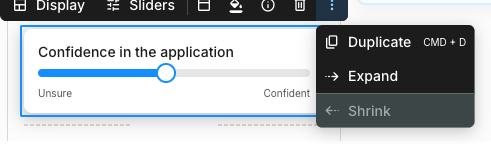
Every other card type carries configuration of its own that has no equivalent elsewhere, like an uploaded image, a set of slider labels, an embed URL, or a connected metric. Those types don't offer conversion at all, so **Change card type** is absent from their three-dot menus.

<figure><img src="https://1197101183-files.gitbook.io/~/files/v0/b/gitbook-x-prod.appspot.com/o/spaces%2For99xDEElfps9uMDY60K%2Fuploads%2Fgit-blob-807f53aa35e177ac327c21d3ae52590a87886107%2Fjourney-maps-card-convert-09-slider-overflow-no-convert-crop.png?alt=media" alt="A selected slider card with its three-dot overflow menu open, listing only Duplicate with a CMD + D shortcut, Expand, and Shrink. There is no Change card type item."><figcaption><p>A slider card's menu has no Change card type</p></figcaption></figure>

To put one of those types in the same slot, delete the card and add the type you want from **+ Add card**. See [Cards](/journey-maps/cards.md) for what each type does.

***

#### What carries over when a card changes type

A conversion changes the card's type in place and keeps everything on it that isn't type-specific:

* Its text, which becomes the new card's content, label, or item title
* Its accent colour and background style
* Assigned personas, card tags, and comments
* Its position in the lane and column, including any columns it spans

<figure><img src="https://1197101183-files.gitbook.io/~/files/v0/b/gitbook-x-prod.appspot.com/o/spaces%2For99xDEElfps9uMDY60K%2Fuploads%2Fgit-blob-a4c4a710f46ffddd876eeb740abafe0476c29fbd%2Fjourney-maps-card-convert-05-after-stage-details-preserved-crop.png?alt=media" alt="A card details panel after a conversion. The Personas section still shows the assigned persona Sofia the first-time saver, the Card tags section shows a Young Adult tag, and a Comments (1) section sits below."><figcaption><p>Personas, card tags, and comments survive the conversion</p></figcaption></figure>

Because only text-based types can convert, there's no type-specific configuration to lose along the way. What does change is the set of controls the card offers. A [stage card](/journey-maps/cards/how-to-use-stage-cards.md) has no card header, for example, so that toolbar button disappears when a text card becomes a stage.

***

#### What happens to the portfolio item

A text or stage card holds its own content. A [portfolio item card](/journey-maps/cards/how-to-use-portfolio-item-cards.md) is a view of an item that lives in your workspace and can appear on several maps. Converting across that line acts on the item too, in one of three ways.

Two common moments to reach for this: promoting a pain point drafted quickly as a text card while you were mapping into a real, trackable item, and converting a pain point you've since worked on into an opportunity or solution once you know what to do about it.

**Converting to a portfolio type creates a new item** - The **Title** and **Description** you confirm become a brand-new item of that type in your workspace, alongside items you [create in the Portfolio](/portfolio/how-to-create-a-portfolio-item.md) directly. It starts with no scores, status, priority, or assignee, so open **Edit \[type]** on the card to fill those in.

**Converting away from a portfolio type only unlinks the card** - The change is instant, with no dialog. The card becomes a text or stage card holding the item's title and description on two lines, and the item stays in your workspace.

<figure><img src="https://1197101183-files.gitbook.io/~/files/v0/b/gitbook-x-prod.appspot.com/o/spaces%2For99xDEElfps9uMDY60K%2Fuploads%2Fgit-blob-a2d828b9b601398bd9ca5087a6f0e94433a1461b%2Fjourney-maps-card-convert-15-portfolio-item-created-not-used-crop.png?alt=media" alt="A row in the Portfolio table for an item left behind by a conversion, showing its key PAI-24, its name, scores of zero, a Used in column reading (not used), No status, a priority of None, and no tags."><figcaption><p>An item whose only card was converted away reads (not used)</p></figcaption></figure>

{% hint style="warning" %}

#### **Important: Converting away from a portfolio type leaves the item behind**

The item is not deleted. It stays in your portfolio with its **Used in** column showing **(not used)**, so repeated conversions build up unused items. Delete the ones you don't want from the **Portfolio** area.
{% endhint %}

If the same item also appears on other journey maps, converting one of its cards away only unlinks that card. The item itself is untouched and stays exactly as it was on every other map that holds it.

**Converting between portfolio types changes the same item** - No second item is created. The item itself becomes the new type, which is why this conversion asks you how its fields should carry across.

{% hint style="warning" %}

#### **Important: Converting between portfolio types changes the item everywhere it's used**

Unlike converting away, this changes the underlying item itself, not just the card. If the item appears on several journey maps, every one of those cards now shows the new type. A pain point converted to a solution stops being a pain point anywhere it appears, since it's the same item.
{% endhint %}

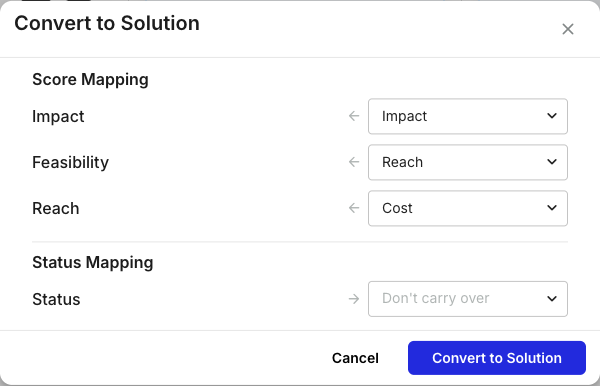
<figure><img src="https://1197101183-files.gitbook.io/~/files/v0/b/gitbook-x-prod.appspot.com/o/spaces%2For99xDEElfps9uMDY60K%2Fuploads%2Fgit-blob-5518bede6a93d158bb3352ec9d5e4c20cc7a13dd%2Fjourney-maps-card-convert-23-pain-point-to-solution-dialog-crop.png?alt=media" alt="The Convert to Solution dialog. A Score Mapping section lists the target type&#x27;s Impact, Feasibility, and Reach dimensions, each with a dropdown naming the source dimension it inherits from: Impact, Reach, and Cost. A Status Mapping section has a single Status dropdown showing Don&#x27;t carry over. Cancel and Convert to Solution buttons sit at the bottom."><figcaption><p>Portfolio type to portfolio type: map the scores and the status</p></figcaption></figure>

* **Score Mapping** - One row per score dimension on the new type, each with a dropdown naming the dimension it inherits its value from. Smaply pre-fills these in order, so check them if the two types score different things.
* **Status Mapping** - Statuses belong to a type, so the item's status is dropped unless you map it. Pick one of the new type's statuses, or leave the default, **Don't carry over**.

The item keeps the **Key** it was first given, a short identifier like `PAI-24`, so a converted item's key prefix can end up naming its old type.

***

#### How to undo a type change

Click the undo button on the zoom control at the bottom-left of the canvas. It reverts the conversion, including the underlying item's type when you converted between portfolio types.

`CMD + Z` (`CTRL + Z` on Windows) does the same, but depends on the canvas having focus, so use the undo button if you've clicked elsewhere since converting.

***

#### Related topics

<table data-column-title-hidden data-view="cards"><thead><tr><th>Article</th><th>What it covers</th><th data-hidden data-card-target data-type="content-ref">Target</th></tr></thead><tbody><tr><td><strong>Bulk edit cards</strong></td><td>Selecting many cards and the full set of bulk actions on the bar.</td><td><a href="/journey-maps/how-to-bulk-edit-cards.md">Bulk edit cards</a></td></tr><tr><td><strong>Cards</strong></td><td>Every card type in a journey map and what each one is for.</td><td><a href="/journey-maps/cards.md">Cards</a></td></tr><tr><td><strong>Portfolio item cards</strong></td><td>What a portfolio item card shows and how it links back to the item.</td><td><a href="/journey-maps/cards/how-to-use-portfolio-item-cards.md">Portfolio item cards</a></td></tr><tr><td><strong>Create a portfolio item</strong></td><td>Creating and scoring an item in the Portfolio instead of from a card.</td><td><a href="/portfolio/how-to-create-a-portfolio-item.md">Create a portfolio item</a></td></tr><tr><td><strong>Stage cards</strong></td><td>Labelling phases and spanning a stage across step columns.</td><td><a href="/journey-maps/cards/how-to-use-stage-cards.md">Stage cards</a></td></tr></tbody></table>


---

# Agent Instructions
This documentation is published with GitBook. GitBook is the documentation platform designed so that both humans and AI agents can read, navigate, and reason over technical content effectively. Learn more at gitbook.com.

## Querying This Documentation
If you need additional information that is not directly available in this page, you can query the documentation dynamically by asking a question.

Perform an HTTP GET request on the current page URL with the `ask` query parameter, and the optional `goal` query parameter:

```
GET https://helpdesk.smaply.app/journey-maps/how-to-change-a-cards-type.md?ask=<question>&goal=<endgoal>
```

`ask` is the immediate question: it should be specific, self-contained, and written in natural language.
`goal` is optional and describes the broader end goal you are ultimately trying to accomplish on behalf of the user. GitBook uses it to tailor the answer towards what is most useful for that goal.

The response will contain a direct answer to the question and relevant excerpts and sources from the documentation.

Use this mechanism when the answer is not explicitly present in the current page, you need clarification or additional context, or you want to retrieve related documentation sections.